| 
Janetta's Pictures
Rew Stop FF
|
|

Origin
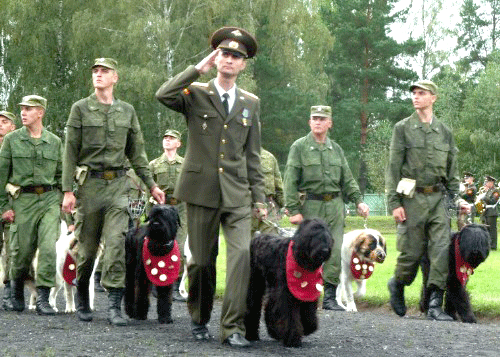
The Black Russian Terrier, originally called the Black Terrier and now known by a variety of names, among them the Russkiy Tchiorny Terrier and Russian Black Terrier, is one of the youngest breeds in the world, dating back only to the 1950s. So successful has its history been that its popularity has earned it the moniker "The Black Pearl of Russia", while many enthusiasts simply refer to the breed as the "Blackie."The short, fascinating history of this breed is admirable and has been remarkably well documented since its beginnings. They were developed in the former USSR in the Red Star Kennel by the state for use as a military/working dog.
Many breeds of dog were involved in the makeup of the Black Russian Terrier, breeds used in the development include the Giant Schnauzer, Airedale Terrier, Rottweiler, Newfoundland, Caucasian Ovcharka and others.
Find the perfect family dog
You may have to wait to find that perfect puppy. Take the time to do your homework. Learn as much as possible about the breed, because the Black Russian Terrier isn’t a dog that should be purchased without thorough consideration and the agreement of all members of the family. Attend a dog show near you (we can help you find one if you’d like) to see the Black Russian Terriers in action.
Puppies are cute and extremely energetic. You must have the time to dedicate to raising the puppy, provide consistent training, mental and social stimulation. This is the best way to ensure your puppy will grow into a stable and calm adult who will be your best friend.
Personality:
Very courageous, self-confident, calm and stable. A highly intelligent thinker who learns because he wants to please and because the work is interesting. They can be stubborn, but does not respond well to force. The breed requires training or can become dominant and insistent. Slow to mature; the protective instinct appears at the age of one and a half to two years, and from that point on, the dog will protect family, home, farm, everything. He will try to take care of his owner both physically and with emotional support. This excellent guardian will warn you of the approach of any stranger. The dog will take cues about how to behave towards particular strangers from the way the owner acts towards them, but will remain always watchful when strangers are present, no matter how many times the person comes to the house. The BRT may try to protect your children from their friends; never leave a BRT unsupervised with children. BRTs are good as farm guards because they are watchful, tend to stay within their territory, and are gentle with farm animals. They are different than many guard dogs in that they need to be with their families. This is not a kennel dog. If left alone too much, the BRT can become aggressive. This breed's temperament has softened over the years, so they are becoming more comfortable with children than they once were. Extensive socialization is the key to a well-adjusted BRT. Socialize early and thoroughly with other dogs and people, otherwise this breed may not tolerate handling by anyone outside the family. Though not usually the one to pick a fight when out walking, male same-sex and dominance aggression may occur.
Black Russian Terriers are excellent in competitive obedience, agility, schutzhund, tracking, guarding and some make good therapy dogs. They love swimming, pulling sleds in winter, running with your bike or hiking with the family.
The BRT is sensitive to their owner. It means that the dog is not likely to challenge their owner.
They are wary with strangers but gentle with its family, including children. They loves human contact and should not be neglected for long periods of time.
It has a very strong protective instinct and, when threatened, will not hesitate to fight to protect its family.
The Black Russian Terrier is dominant by nature. It's better not to have another large dominant dog living in the same house. They are fine with smaller, non-dominant dogs and other pets, including cats. These dogs love to please their owners, are easy to train and rarely bark for no reason.
Grooming
Black Russian Terriers are a non-shedding breed but should be brushed regularly to remove dead hair, prevent knots and matting.
Trim the hair under the paws and in the ear ducts. Professional grooming is recommended every 8 weeks or so.
 |
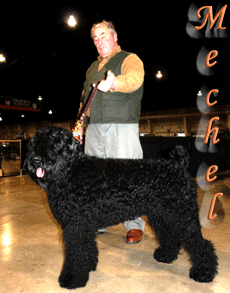
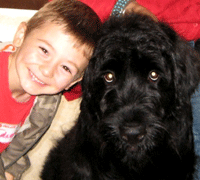
Temperament of our dogs is very impressive.
We are always on dog shows with different our dogs and we never had any bad experience near or on a ring.
Our dogs are friendly with big respect to handler and all others.
Many people thinking, BRT ‘s are very serious dogs and can not be owned by people, who has any experience
with any
working dogs. This is not a true. Anyone can be great BRT owner. As any small or big breed our dogs loves fun,
excitements,
spending time with there owner, go in public to be pet and be photo model.
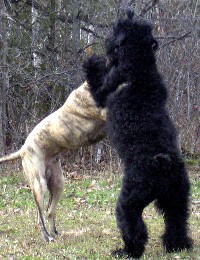
Dogs does not know there size
and all from small to big breed they are acting the same.
It is our job to teach growing puppies to good manors. Most of our dogs has much better menners
than people do.
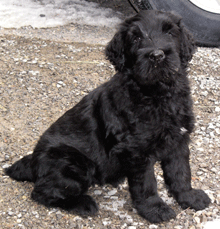
Don’t be afraid to bring young BRT pup in your family. Maybe it will be your best dession in your life.
    |